From mAbs to Oligos, We Have You Covered
Phenomenex is committed to the development of novel chromatographic solutions that advance biopharmaceutical development. This rapidly-growing industry necessitates fit for purpose applications and innovative technologies to meet the expanding analytical challenges of the field.
Phenomenex columns and sample preparation solutions are designed to tackle the multi-faceted analytical needs of large molecule analysis, particularly in the area of biopharmaceutical analysis. Leveraging cutting-edge technology and expertise, our biopharmaceutical solutions provide tailored support for accurate and reliable results in this specialized field.
Family
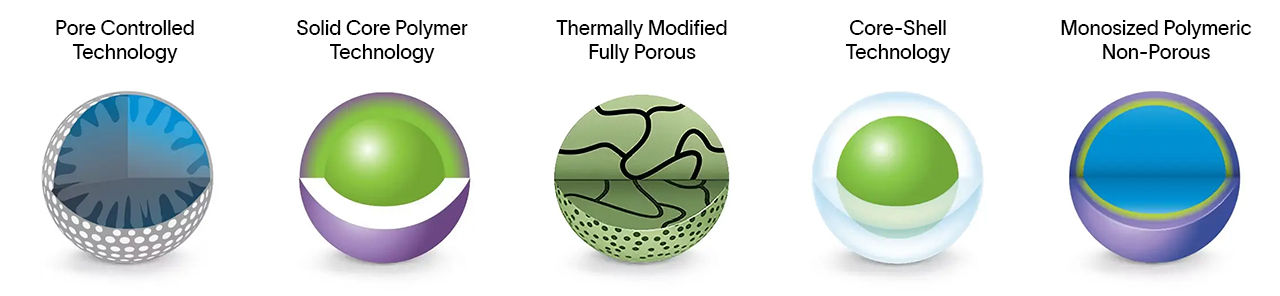
Five Advanced Particle Platforms
All five of the Biozen particle platforms were individually designed and built by Phenomenex to take advantage of integral levels of performance, ruggedness, and reproducibility for protein characterization applications. Individually, each platform differs in the proprietary processing techniques used to control particle size and morphology.
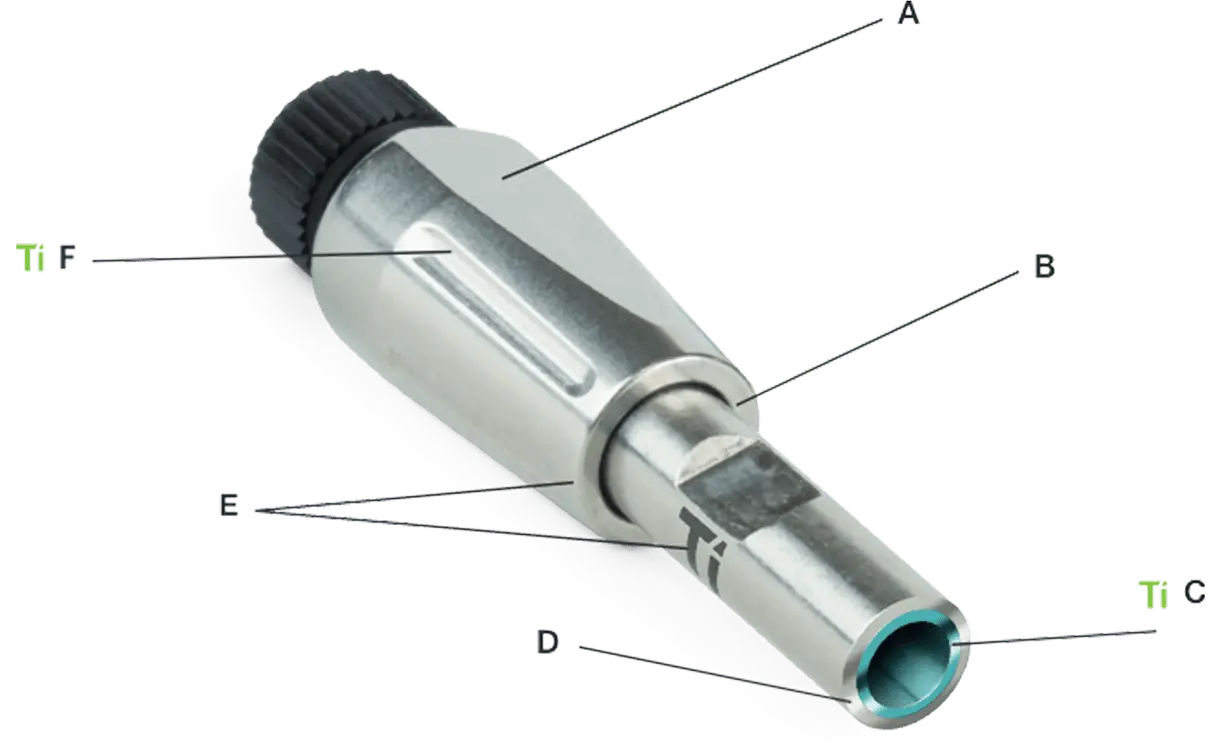
Inside Biozen BioTi Hardware
A: UHPLC Pressure Rating
Allows for more experimental design space; room to increase flow rates for increased throughput
B: Better Controlled ID Versus PEEK Hardware
Improved column-to-column performance, providing more consistency and easier method validation
C: Biocompatible Titanium Liner
D: Improved Recovery and Peak Shape
Better column-to-column consistency, ease of use, and troubleshooting
E: Strong Stainless Steel Walls Help Prevent Movement Under Pressure
F: Biocompatible Titanium Frit
Biocompatible Flow Path with BioTi Hardware
Keep your mind at ease knowing that we’ve minimized the need for priming with a new titanium infused biocompatible hardware and frit that doesn’t interfere with protein or peptide integrity!
4 Advanced Particle Platforms
All four of the Biozen particle platforms were individually designed and built by Phenomenex to take advantage of integral levels of performance, ruggedness, and reproducibility for protein characterization applications. Individually, each platform differs in the proprietary processing techniques used to control particle size and morphology.
Pore Controlled Technology
Monosized Polymeric Non-Porous
Core-Shell Technology
Thermally Modified Fully Porous
8 Particle Chemistries
ul>
Biozen dSEC : 1.8 µm and 3 µm
Biozen Intact XB-C8 : 3.6 µm
Biozen WidePore C4 : 2.6 µm
Biozen Glycan : 2.6 µm
Biozen Oligo : 1.7 µm and 2.6 µm
Biozen Peptide XB-C18 : 1.7 µm and 2.6 µm
Biozen Peptide PS-C18 : 1.6 µm and 3 µm
Biozen WCX : 6 µm
Inside Biozen BioTi Hardware
UHPLC Pressure Rating More experimental design space
More experimental design space, with room to increase flow rates for increased throughput
Better Controlled ID Versus PEEK Hardware
Improved column-to-column performance, providing more consistency and easier method validation
Improved Recovery and Peak Shape
Better column-to-column consistency, ease of use, and troubleshooting
Biocompatible Titanium Liner
Biocompatible Titanium Frit
Strong Stainless Steel Walls Help Prevent Movement Under Pressure
Inside Biozen Particle Platforms
Thermally Modified Fully Porous
Through a proprietary thermal processing series of steps, we eliminate micropores and further improve consistency, column efficiency, inertness, ruggedness, and reproducibility.
Core-Shell Technology
Using sol-gel processing techniques that incorporate nano structuring technology, a durable, homogeneous porous shell is grown on a solid silica core. This highly optimized process combined with industry leading column packing technology produces highly reproducible columns that generate extremely high efficiencies and sensitivity.
Monosized Polymeric Non-Porous
Meticulously controlled monosized particle technology secures incredible particle consistency that leads to improved and reliable efficiency. This innovative non-porous particle serves as the perfect backbone for complex ion-exchange chemistries.
Pore Controlled Technology
The Biozen dSEC columns are packed with low pore volume silica coupled with a proprietary hydrophilic diol-type bonded surface chemistry that prevents the silica surface from interacting with protein samples.